
What are the rivets for?
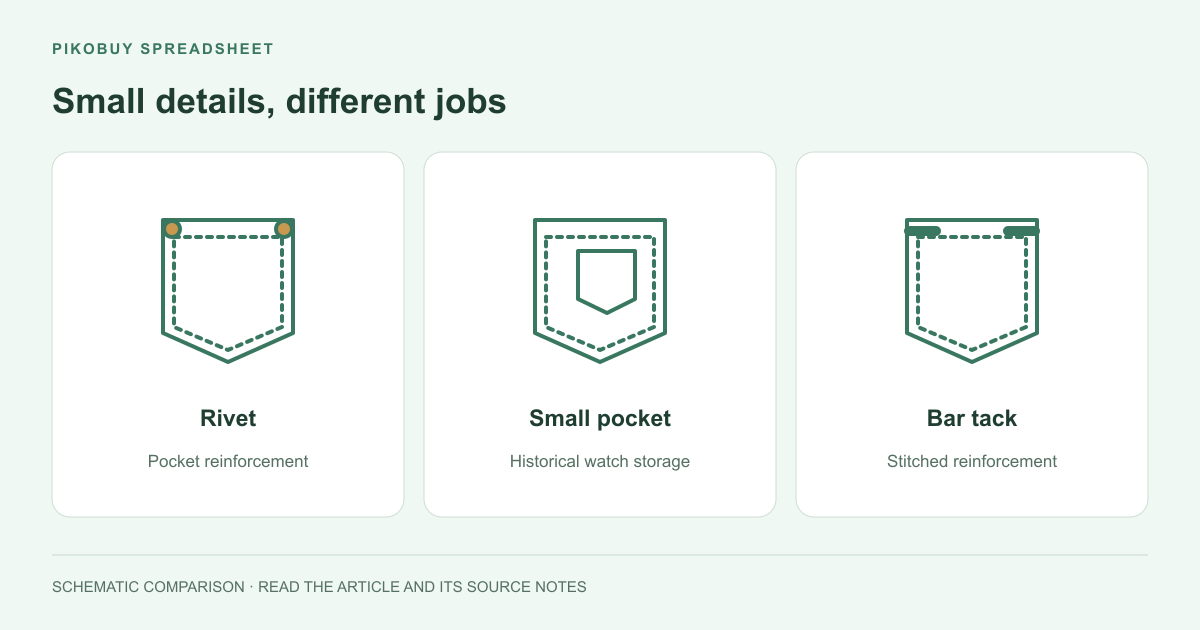
Levi Strauss & Co.’s pocket history connects the riveted construction to the 1873 patent received with Jacob Davis. It describes rivets strengthening the pocket openings against tearing. Their location matters: they reinforce particular points, rather than making every part of the trousers equally resistant to wear.
That distinction is useful when looking at a contemporary pair. A visible rivet tells you about a construction detail at an opening. It does not report the strength of the seat seam, the fabric’s abrasion behavior or the quality of a different pair using similar-looking hardware. More metal is not a complete durability specification.
Was the little pocket really an extra fifth pocket?
The company’s archive identifies it as a watch pocket, designed for a pocket watch in the nineteenth century. It also explains that the early arrangement already included this small pocket, three pockets at the front in total and one at the back. The second rear pocket arrived in 1901 in that account.
The modern habit of calling the little compartment the fifth pocket can therefore obscure the sequence. Its small size makes more sense when understood as storage for a particular object, rather than as an arbitrary decoration added after four large pockets. Today it can be used differently while retaining that recognizable position inside the front-pocket arrangement.
Why do many back pockets use stitching instead of exposed rivets?
Levi Strauss & Co.’s account of rear-pocket rivets describes complaints about scratched furniture and saddles. In 1937 the company concealed the rivets under fabric. The metal eventually wore through, and in 1966 the company replaced those rear-pocket rivets with bar tack stitching.
This is a documented design trade-off: reinforcement had to coexist with the surfaces the wearer sat on. Replacing a metal part with stitching was a change of solution, not simply the disappearance of concern for strength. It also shows why a photograph without visible rear rivets cannot, on that fact alone, establish that a pair is poorly constructed.
| Detail | Documented purpose or change | What appearance alone cannot settle |
|---|---|---|
| Pocket-opening rivet | Local reinforcement | Durability of the complete garment |
| Small front pocket | Pocket-watch storage | The intended use of every modern version |
| Concealed rear rivet | Reduced scratching of other surfaces | Whether an individual old pair retains hidden metal |
| Rear-pocket bar tack | Later reinforcement using stitching | Overall strength without examining construction |
What does this history help you understand when comparing jeans?
It explains why two recognizable pairs can use different hardware without one necessarily being an incomplete version of the other. A designer may preserve an older appearance, adopt a later pocket reinforcement or change the cut around familiar details. The archive reference and the current garment’s behavior remain separate information.
For someone choosing a pair, the meaningful distinction is between a historical feature and evidence about the offered item. A watch pocket explains a shape; a rivet explains a local construction choice. Neither determines the rise, leg width, washed dimensions or authenticity of a separate listing. Those questions need the actual garment’s records, not a verdict based on one heritage detail.
Browse pants and shorts · How repair and alteration services differ
Rivets and the watch pocket have practical origins, but an individual historical detail cannot grade or authenticate an entire modern pair of jeans.
References and source notes
Sources checked Oct 21, 2026. Links open in a new tab.
- Levi Strauss & Co. — Pockets Full of History Company archive account of rivet purpose, the watch pocket and the 1901 second rear pocket. The history concerns the company’s designs rather than every maker’s jeans.
- Levi Strauss & Co. — The 80-Year Coverup Historian’s account of concealed rear rivets in 1937 and replacement by bar tack stitching in 1966. No individual garment is dated or authenticated here.