
Why can a warm-looking fleece let wind through?
Polartec’s insulation explanation describes raised pile trapping air and distinguishes several fleece constructions. Insulation and resistance to air movement are related but different properties. A fleece can therefore be useful as an insulating layer without its visible surface establishing a wind barrier.
This explains a common comparison problem: a thick-looking pile and a smooth fabric photograph do not tell you which finished garment reduces airflow more. The pile is a visible feature, while airflow depends on the underlying construction and any additional layers. Surface appearance alone cannot settle the weather specification.
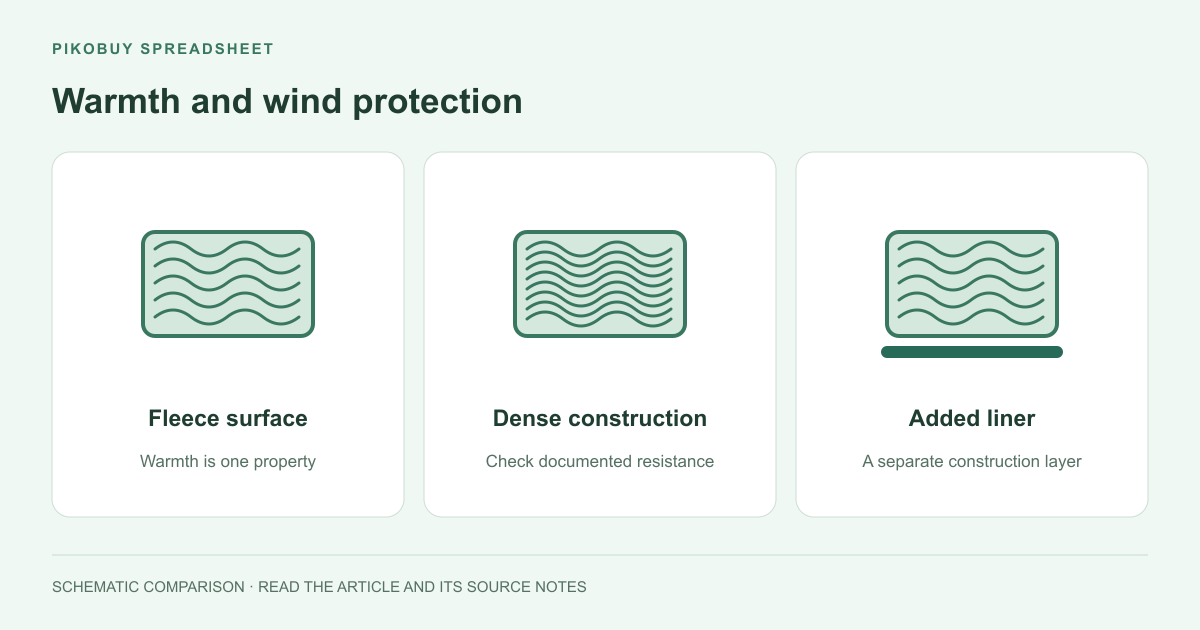
Wind Pro uses a different construction from an added liner
Polartec describes Wind Pro as a tightly knit, wind-resistant fleece whose construction does not rely on a film or laminated fabric layers. This is the manufacturer’s description of a particular fabric family. It should not be transferred to an unrelated product merely because its listing also uses the word fleece.
The distinction is useful because stronger wind resistance need not always come from a separate lining. But “more resistant” is not the same claim as a waterproof garment. Polartec itself describes Wind Pro as water repellent rather than fully waterproof. Wind behavior and rain protection still need separate descriptions.
Retro-X illustrates a fleece with a windproof liner
Patagonia’s current Retro-X collection describes a windproof liner alongside its fleece outer surface. This is another documented approach: the fluffy face and the layer limiting wind perform different roles within the garment. The collection description does not establish that every fleece carrying a similar appearance has that liner.
It also shows why model and version matter. A claim about a specified Retro-X release is evidence about that release, not a permanent description of all fleece jackets or of a different seller’s item. When comparing listings, the useful field is the documented liner or fabric construction, rather than an inference based on a recognizable silhouette.
| Description | What it addresses | What it leaves unanswered |
|---|---|---|
| Fleece pile / insulation | An insulating surface and construction | The garment’s resistance to wind |
| Wind-resistant knit | Reduced airflow through a specified construction | A complete waterproof rating |
| Windproof liner | An additional wind-blocking layer in the stated product | Whether a similar-looking item has the same liner |
What information helps compare two fleece jackets?
Look for an identified fabric family, a description of the liner and separate statements about wind and water. These fields explain more than a generic thick or warm label. If a listing does not identify the construction, the wind-protection question remains open; adding a familiar fabric name in a title does not independently verify it.
There is also no universal comfortable temperature supplied by a fleece category name. Activity, other layers and the finished garment all remain part of its use. This article distinguishes the material claims rather than promising a weather outcome or repeating the guide’s garment-measurement steps.
Browse hoodies and fleece layers · Why fabric weight is a separate measurement
Warmth, wind resistance and waterproofing are different claims. An identified knit or liner tells you more about wind protection than the appearance of fleece pile.
References and source notes
Sources checked Oct 21, 2026. Links open in a new tab.
- Polartec — Insulation fabric families Manufacturer’s explanation of pile insulation and differing constructions. No universal temperature or garment rating is inferred.
- Polartec — Wind Pro Primary description of a tightly knit wind-resistant construction and its water-repellent limitation. Promotional multipliers are not used as independent test results.
- Patagonia — Retro-X fleece collection Current collection description identifying a windproof liner. Applies to the stated product family and release, not every fleece or third-party listing.