
A repeated picture does not identify the offer
A familiar photo can make two entries look interchangeable even when they lead to different offers. The image describes an appearance; the seller listing identifies an offer; the selected color, size and quantity identify what is being priced. A directory card often compresses those separate fields into one title and one number.
The public Pikobuy.to spreadsheet illustrates how one catalog can be organized through categories and model or price collections. A product’s appearance in more than one browsing context does not necessarily add another independent seller or another distinct item. Likewise, similar images alone cannot establish that two sellers supply the same construction or batch.
In Pikobuy Spreadsheet, browse by category and budget, then open individual listings to check the current offer.
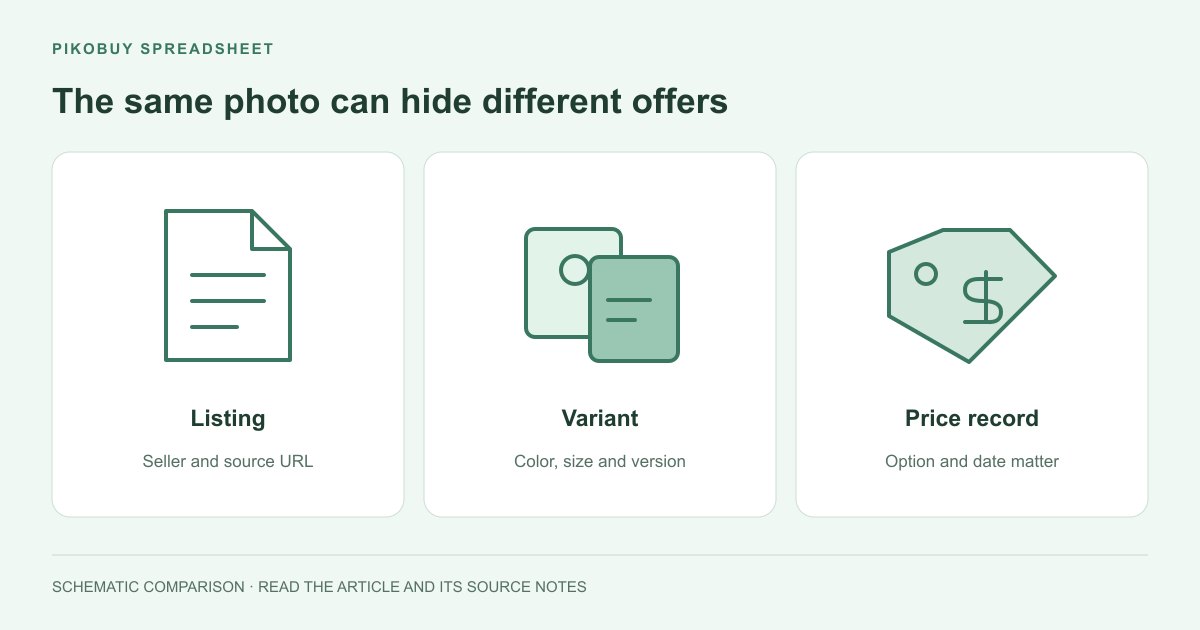
Three kinds of repetition lead to different comparisons
Baymard’s product-list usability research found that showing variations as separate entries can make a range harder to understand and a desired variation harder to locate. That finding concerns interface design, rather than the quality of products in a particular Pikobuy directory. It explains why a long list can feel varied while repeatedly showing one underlying design.
The distinction matters when counting your actual choices. Six colors of one shirt offer color choice. Six different cuts offer design choice. Two records pointing to the same seller option may offer no additional choice at all. Keeping those cases separate makes a smaller set of candidates easier to compare.
| What matches | What could differ | How to interpret the repetition |
|---|---|---|
| Same seller listing | Color, size or quantity | Several variants of one offer |
| Similar photo, different seller links | Construction, included pieces or service | Separate offers; image similarity does not establish equivalence |
| Same listing and exact option | Directory placement or recorded date | Potentially a repeated record, not another product |
The lowest card price may describe a different option
Consider an illustrative comparison, not an observed sale. Card A shows ¥90, but the color and size you want currently cost ¥118. Card B shows ¥110 and its selected option also costs ¥110. The card order suggests that A is cheaper; the selected-option prices reverse that order. Neither comparison yet proves that the garments have identical construction.
Quantity creates a second possible mismatch. A price for one item and a price for a multipack need a common unit before they can be compared. Currency and included pieces matter for the same reason. A difference only becomes a useful saving once the two numbers describe sufficiently comparable offers.
A saved price is a record, not a standing quotation
Pikobuy’s official shopping guide states that purchase prices are subject to the actual purchase and that an out-of-stock order is refunded. A saved spreadsheet number therefore belongs to a particular observation. If the live option has changed, the old number can remain an accurate historical note without remaining an available offer.
An old link opening a store page, a missing item or an unexpected option breaks the comparison in a different way. It leaves the current offer unidentified. A cheaper remembered number cannot repair that gap. The useful result of reopening the link is either a confirmed current option or an explicitly unresolved candidate—not an assumption that yesterday’s offer still exists.
Count distinct candidates, then compare their current offers
A useful shortlist might contain three genuinely different cuts rather than nine near-identical thumbnails. That does not require deleting color choices: it means treating color variation and design variation as different information. It also prevents a repeated record from receiving the apparent weight of several independent recommendations.
Price comparisons then have a clear subject: the selected option, its unit and its current seller link. If an essential field is missing, the comparison remains open. This is more informative than ranking a whole spreadsheet from its lowest displayed number, because it shows whether the supposed bargain is actually available in the version being considered.
Browse product categories · Separate item prices from the delivered budget
Compare current offers for identified options. Repeated images, repeated records and multiple colorways are different things—and none makes the lowest thumbnail price a like-for-like bargain.
References and source notes
Sources checked Oct 21, 2026. Links open in a new tab.
- Pikobuy.to — Spreadsheet index Independent directory used as an observable example of category and collection organization. No catalog-count or quality claim is adopted.
- Baymard Institute — Combine Variations of Products into One List Item First-party usability research on separating product variants into list entries. Applying that distinction to spreadsheet records is the analysis here.
- Pikobuy — Official shopping guide Supports the distinction between saved reference prices and the actual purchase, and the published out-of-stock handling. The ¥90/¥118/¥110 comparison is hypothetical, not a live quote.