
200 GSM and 300 GSM describe a measurable difference
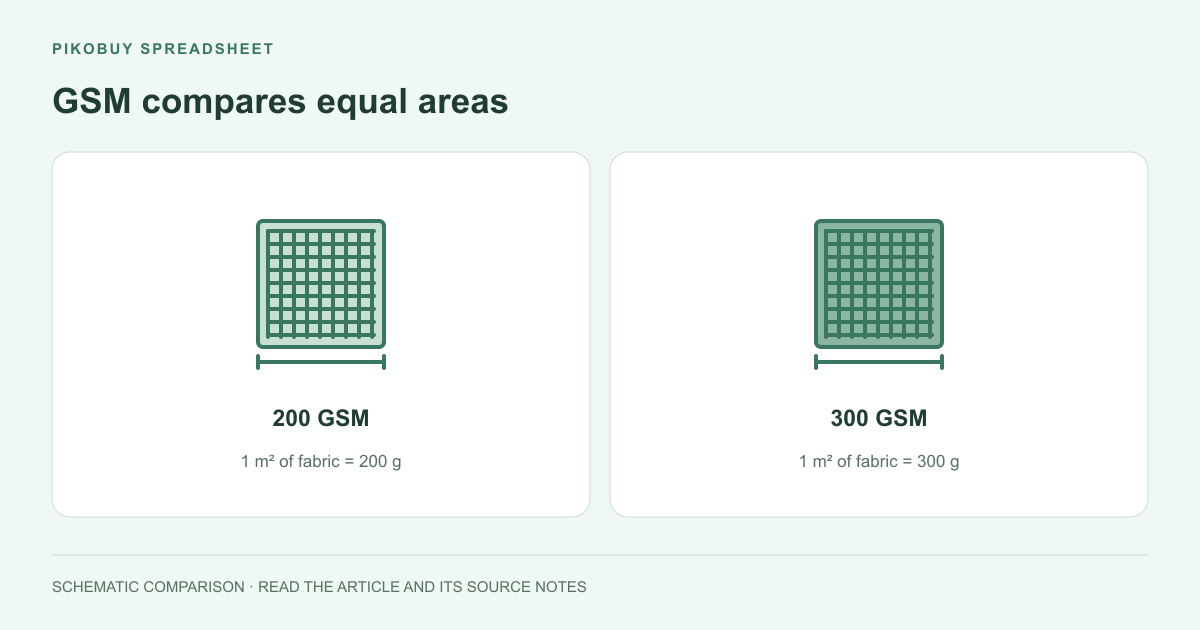
ASTM D3776/D3776M describes fabric mass per unit area as a measurement in its own right. GSM expresses that mass in grams per square meter. With equal-area samples, 300 GSM fabric has 50% more mass than 200 GSM fabric. It does not follow that a finished 300 GSM shirt will be 50% heavier: the pattern, size, ribbing and decoration also affect garment weight.
For an illustrative half-square-meter sample, the two masses would be 100 g and 150 g. These are calculations for equal areas, not material-consumption figures for a named shirt. They explain why a shipping weight in grams cannot simply be read as the main fabric’s GSM.
| Fabric specification | Sample area | Calculated sample mass |
|---|---|---|
| 200 GSM | 0.5 m² | 100 g |
| 240 GSM | 0.5 m² | 120 g |
| 300 GSM | 0.5 m² | 150 g |
Heavier and thicker are different claims
ISO 5084’s public abstract describes measuring textile thickness under specified pressure. Thickness is a dimension; GSM is mass divided by area. Two specifications can therefore be useful without being interchangeable. “300 GSM” supplies a weight-per-area claim. It does not supply a thickness measurement or describe how the surface feels.
This distinction matters when a listing uses heavy, soft and thick as if they were one promise. A buyer interested in an outer layer may want a particular outline; someone wearing a tee beneath another garment may prefer less bulk. The deciding evidence concerns the finished fabric and garment, not a universal rule that the larger number is the better purchase.
A heavyweight label does not predict the washed size
Cotton Incorporated’s technical bulletin identifies knitting, processing tension, relaxation and finishing as influences on dimensional stability. That gives shrinkage its own explanation. A stated cotton content and a high GSM number do not report how a particular shirt changed after washing.
Suppose, purely as an arithmetic example, a shirt’s measured length changes from 74 cm to 71 cm. That is about a 4.1% reduction in length. It says nothing about width unless width was also measured, and it does not establish that every size or color behaves identically. A reported result becomes more useful when the same measurement points, wash count and drying method are known.
ISO 6330 specifies washing and drying procedures for textile testing, which illustrates why conditions belong beside a test result. A seller’s “prewashed” description is a process claim; a before-and-after measurement is an observation. One should not be silently substituted for the other.
Compare the evidence behind the quality claim
Imagine two listings: A states 300 GSM and “premium”; B states 240 GSM and provides clearly identified garment measurements before and after a described wash. Neither automatically wins. A has the higher reported fabric mass, while B answers more about dimensional change. If stable length matters most, B’s measurements are more relevant than A’s larger weight number.
A collar that stays in shape, seams that hold and a surface that resists pilling are further questions. The comparison should name the behavior and the available evidence. A fabric-weight figure cannot answer all three, and an attractive close-up cannot establish months of wear. Where that evidence is absent, the conclusion is “not established,” rather than an invented quality score.
| Concern | Relevant information | An incomplete substitute |
|---|---|---|
| Fabric mass | GSM for the identified fabric | Finished parcel weight |
| Thickness | A thickness measurement with conditions | GSM alone |
| Washed fit | Before/after dimensions and wash conditions | A heavyweight or cotton label |
| Collar or surface durability | Evidence directed at that behavior | A premium label or a single new-item photo |
Choose the property you need, rather than a universal GSM winner
The useful conclusion can be specific: one listing reports more fabric mass; another provides better fit information; neither documents long-term collar behavior. This is enough to identify what is known without pretending the offers have been wear-tested. It also explains why broad tables labeling all high-GSM shirts premium are a poor substitute for product-specific evidence.
When browsing T-shirt finds, keep the desired cut and use in view, then compare the same type of information across candidates. If the main uncertainty is fit, use the separate measurement guide. If it is washed stability, a larger GSM number does not resolve it. There is no need to turn a personal preference for weight into a claim that every lighter shirt is inferior.
Browse T-shirts and jerseys · Compare garment measurements for fit
GSM answers how much fabric mass occupies a given area. Compare thickness, washed dimensions and durability on their own evidence before treating “heavier” as “better.”
References and source notes
Sources checked Oct 21, 2026. Links open in a new tab.
- ASTM — D3776/D3776M fabric mass per unit area Public abstract and scope establish the measurement category. No paid standard text is reproduced; equal-area sample masses are arithmetic examples.
- ISO — 5084 textile thickness Public abstract identifies thickness measurement under specified pressure. No listing here is claimed to have been tested to this standard.
- Cotton Incorporated — Wet Processing of 100% Cotton Knitted Fabrics Industry bulletin on construction, processing and dimensional stability. It is not a test report for any product in the directory.
- ISO — 6330 domestic washing and drying procedures Public scope supporting the importance of defined test conditions. The 74-to-71 cm and A/B listing scenarios are hypothetical, not physical trials.