
Which features make the shape recognizable?
Carhartt’s company history says its archive holds Chore Coat advertisements dating to 1917. That documents the maker’s long association with the garment; it is not proof that the entire category began in that year. The working-jacket reference helps explain the emphasis on accessible pockets and a relatively direct front layout.
A patch pocket is attached to the garment’s surface, making its outline part of the appearance. Several visible pockets can give an otherwise plain jacket a strong arrangement of shapes. A workwear-inspired coat may keep that arrangement even when it is made for everyday clothing rather than a specific job. Appearance alone does not establish protective workwear certification.
Does chore coat mean the same fit in every version?
Carhartt WIP’s own comparison distinguishes the Michigan Coat, cut closer to the body, from the boxier, more oversized OG Chore Coat. These are descriptions of the brand’s named versions. They provide a concrete example of different proportions inside one recognizable chore-coat family.
The practical consequence is that a similar front pocket layout cannot stand in for the cut. A closer body and a roomier body can create different outlines while preserving the same general reference. If one listing says Michigan and another says OG, keeping those names attached to the comparison is more informative than treating both simply as the same brown jacket.
Is a chore coat automatically a heavy winter jacket?
No. Carhartt WIP describes seasonal versions in canvas or denim, including lighter constructions and lined or quilted options. The category name therefore leaves the lining and fabric specification open. A photograph of a familiar workwear shape does not establish what sits behind its outer fabric.
An unlined example and a quilted version can share collars and pockets while serving different layering needs. The relevant distinction is the actual construction, rather than the assumption that a workwear origin always means heavy insulation. The same caution applies to stiffness: a fabric finish or wash can change the impression without changing the category name.
| Description | What it helps identify | What to establish separately |
|---|---|---|
| Chore coat | A workwear-derived design family | Fabric, lining and exact proportions |
| Michigan or OG in Carhartt WIP’s range | A named version with a different cut | The specific seasonal item’s construction |
| Canvas or denim | The stated outer fabric | Weight, finish and washed behavior |
| Lined or quilted | An added construction layer | Its material and the finished garment’s dimensions |
What makes a useful comparison between two chore coats?
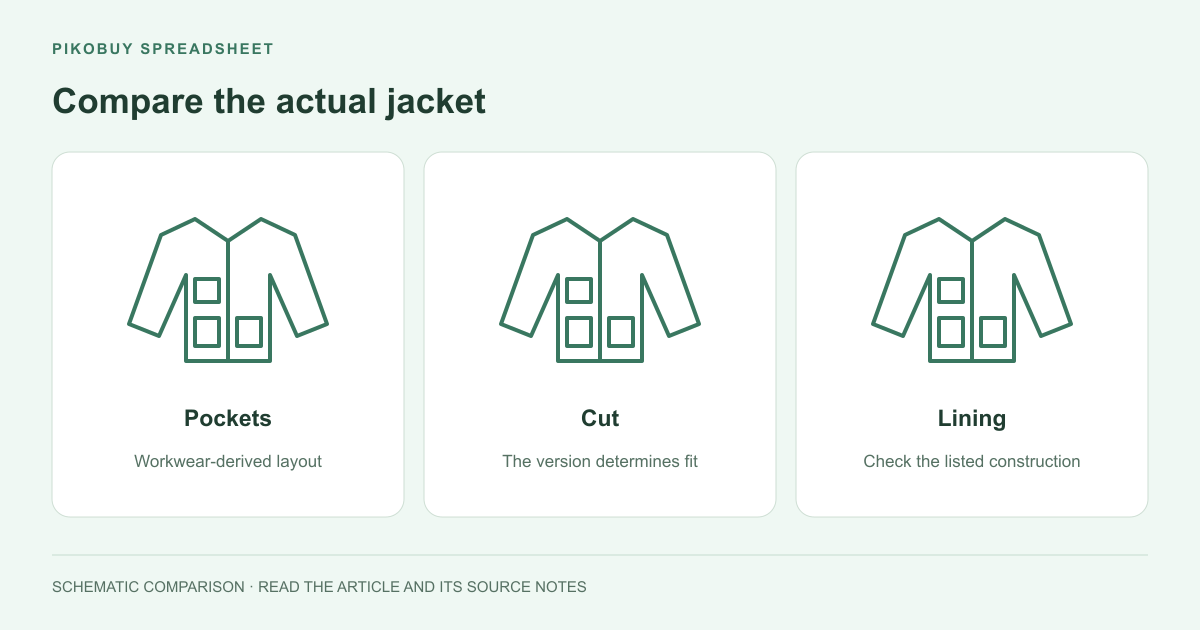
Keep three decisions visible: the version’s cut, the outer fabric and the lining. A pocket arrangement can explain why two jackets look related, but those three details explain why they may feel like different options in a wardrobe. There is no need to invent one correct chore-coat silhouette to describe the difference.
This is a design comparison rather than a size-chart tutorial. The article can identify a closer or boxier named version; choosing dimensions still requires the specific item’s measurements. For that next step, the separate sizing guide supplies the method without repeating it in every outerwear article.
Browse jackets · Compare the measurements of a specific jacket
A chore coat is a recognizable family, not one fixed specification. Cut, outer fabric and lining distinguish the actual versions being compared.
References and source notes
Sources checked Oct 21, 2026. Links open in a new tab.
- Carhartt — Company history Maker’s archive account of advertisements dating to 1917. This is not presented as the universal invention date of the category.
- Carhartt WIP — Chore Coats: Michigan and OG styles Primary comparison of named cuts and seasonal constructions. Examples describe that manufacturer’s range, not every jacket using similar style names.