
A 2 kg screenshot leaves most of the shipment unspecified
Pikobuy’s public estimator asks for destination, product type, weight and three package dimensions. Its official guide also distinguishes shipping routes by time and billing method. Weight is one input within that picture, rather than a complete description of the service being priced.
A screenshot saying only “2 kg shipping” might concern a different destination, a different route or a parcel with much less empty space. Until those conditions are visible, a lower total cannot establish that your route is overpriced. The two numbers may be accurate records of different shipments rather than competing prices for an identical service.
Compare items in Pikobuy Spreadsheet, then estimate shipping separately using the actual parcel details.
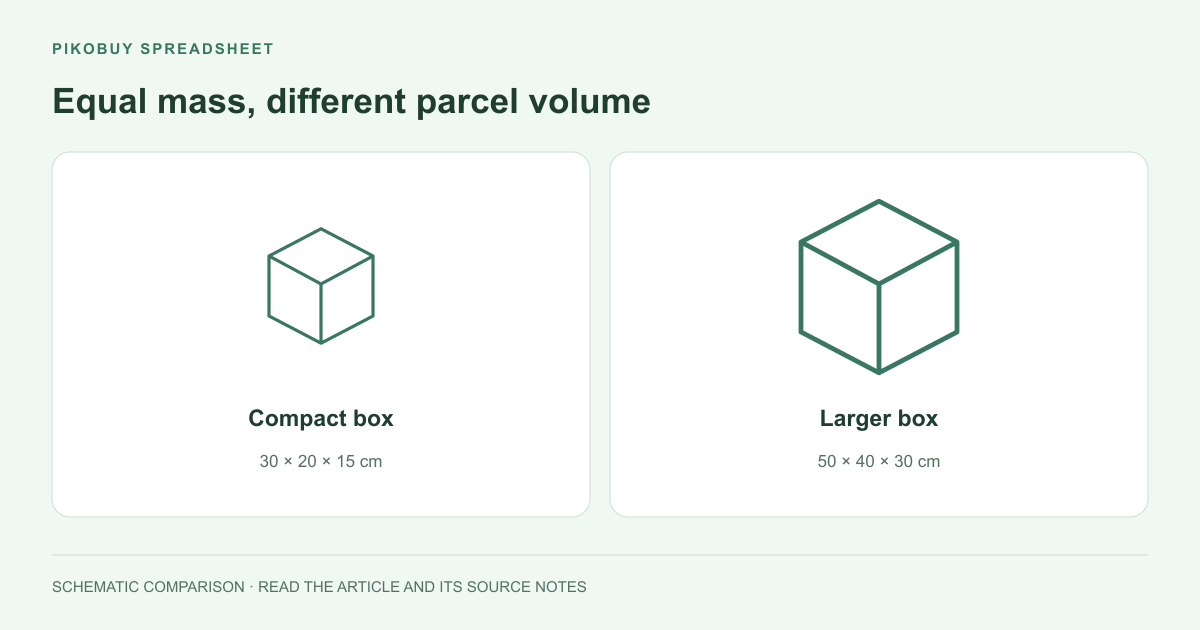
The same contents can occupy a different billable space
DHL UK’s weight-and-dimensions explanation uses length × width × height divided by 5,000 to calculate volumetric weight, then compares it with actual weight. This supplies a documented carrier example; it is not a universal divisor for Pikobuy routes.
Apply that example to two hypothetical 2 kg boxes. At 30 × 20 × 15 cm, the volumetric figure is 1.8 kg. At 40 × 30 × 20 cm, it is 4.8 kg. The same higher-of-two comparison therefore starts from 2 kg for one parcel and 4.8 kg for the other, before the relevant service’s rounding or other charges. No freight price follows from this arithmetic alone.
| Parcel | Actual weight | Packed dimensions | Volumetric result | Higher figure before route-specific rounding |
|---|---|---|---|---|
| Compact | 2 kg | 30 × 20 × 15 cm | 1.8 kg | 2 kg |
| Larger | 2 kg | 40 × 30 × 20 cm | 4.8 kg | 4.8 kg |
A smaller box does not guarantee a lower final quote
Suppose the larger example is repacked to 35 × 25 × 20 cm while remaining 2 kg. Under the same illustrative divisor, the volumetric result becomes 3.5 kg. That reduces the starting figure compared with 4.8 kg, but the eventual saving still depends on the route’s rate bands, rounding and minimum charge. It is not a fixed percentage discount.
By contrast, reducing the compact box’s volume further would not lower its higher-of-two starting figure below its unchanged 2 kg actual weight. This is why two buyers can report different results from removing packaging. Packing can also provide protection: a reduction that helps a dimensional calculation is not automatically an acceptable trade for a fragile or shaped item.
The quote date and included charges can reverse a comparison
FedEx’s U.S. fuel-surcharge page says adjustments can occur weekly and that the customer agreement controls the calculation and adjustment frequency. That carrier example explains why a saved quote needs a date. It does not establish that a shopping agent passes through FedEx retail surcharges or uses the percentages shown on that page.
There is also a difference between a base transport charge and a payable total. A comparison remains incomplete when one screenshot includes an optional service, a discount or an added charge that the other omits. Before calling a route cheaper, identify the same cost scope and discount conditions. A lower first line can coexist with a higher final total.
What would make the two quotes genuinely comparable?
The useful comparison is a shared packed parcel sent to the same destination, with the product category accepted by both quoted services. Then the exact route, chargeable weight, rate date and included charges can explain the remaining difference. If those fields are missing from another buyer’s screenshot, treat it as background about one shipment rather than as a personalized quote.
This also separates two decisions. The shipping article explains why totals differ; the budget guide helps keep the purchase price and parcel allowance apart. Neither a low product-card price nor a previous buyer’s freight bill establishes the delivered cost of a new shortlist.
| Missing field | Why the comparison remains open |
|---|---|
| Packed dimensions | Two equal-weight parcels can use different billable space |
| Exact route and destination | The service and journey being priced are unclear |
| Quote date | The applicable rate period may differ |
| Included fees and discount conditions | A base price may be compared with a different total |
Keep item and parcel costs separate in your budget · Read the shipping-policy explanation
A useful shipping benchmark describes the packed parcel, route, destination, date and payable total. “2 kg” alone cannot explain whether two quotes are pricing the same service.
References and source notes
Sources checked Oct 21, 2026. Links open in a new tab.
- Pikobuy — Official shipping estimate Public estimator fields checked for destination, product type, weight and package dimensions. No live shipment was submitted or quoted.
- Pikobuy — Official shopping guide Published distinction between route billing methods and delivery times. The article focuses on comparing quotes rather than repeating the ordering workflow.
- DHL UK — Weight and Dimensions Carrier example of a 5,000 divisor and higher-of-actual-or-volumetric comparison. All box dimensions and repacking comparisons here are illustrative; actual Pikobuy route rules must be checked separately.
- FedEx — U.S. fuel surcharges Supports dated rate comparisons and the role of customer agreements. No published FedEx percentage is represented as a Pikobuy fee.